Blog / Cash flow
Why your bank balance isn't your profit (and what is really yours to spend)
Your bank balance is different from your profit because money moves in and out of the account on a different schedule than the work. Deposits arrive before the job is done, materials get paid before the customer pays, and owner draws and last year's taxes leave the account without ever showing up as a cost of this year. So the balance tells you what is in the account today, not what you earned and not what you can spend.
That gap is where a lot of bad decisions come from. A new truck bought on a good bank balance. A bonus paid out of a customer's deposit. A slow January that nobody saw coming.
This article picks up where Revenue, profit, cash left off. That one explained the three numbers. This one starts from the bank and shows how to get from the balance to the number you can actually use.
Your bank balance is not yours
Look at the balance this morning. Some of that money belongs to customers, because you still owe them a finished job. Some belongs to suppliers and your crew, because their bills are due in the next few weeks. Some belongs to the IRS and the state, because profit creates a tax bill.
What is left after all of that is yours. In most contractor companies it is much smaller than the balance, and in a busy season it can be close to zero even when the account looks healthy.
The opposite also happens. A business can have a very good year on paper and very little in the bank. Profit is real, it is just sitting somewhere else: in unpaid invoices, in materials on a job that hasn't billed yet, or in the owner's personal account.
Four places the money goes (or comes from)
1. Customer deposits
A deposit makes the balance go up, but you haven't earned it yet. Materials, crew and subs for that job are still ahead of you. If the deposit gets spent on last month's bills, the job will be paid for later with money from the next job. That works until the jobs slow down.
Busy spring: lots of deposits, the account looks great. Late fall: deposits dry up, the work still has to be finished, and the balance drops fast.
2. Materials paid before the customer pays
You order shingles, lumber or equipment today and pay the supplier in 30 days or less. The customer, or the insurance company, pays when the job is done, and sometimes weeks after that. Every job in progress holds some of your cash.
That is why growth can feel like a cash problem. More jobs at the same time means more money paid out ahead of the money coming in. The profit is there. It is just not in the bank yet.
3. Owner draws
For a one-owner company, draws are often the biggest single thing that leaves the account. They don't belong to any job and they are not an expense in the Profit and Loss, so the profit number never shows them. The bank does.
Nothing is wrong with paying yourself. The problem is when draws follow the bank balance instead of the profit. A big deposit lands, a big draw follows, and the job that deposit was for runs short later.
4. Last year's taxes
Taxes on last year's profit are often paid this year: in April with the return, or as estimated payments during the year. That cash leaves now, but the profit that created it was earned before. If nothing was set aside back then, this year's cash pays for last year's work. More on setting money aside in how much a roofing company should set aside for taxes, and ask your CPA how it applies to you.
How the gap adds up: one example
Here is one company, January to October. Profit was good. The bank balance tells a different story, and each line explains part of the difference.
| From profit to the bank balance | Amount |
|---|---|
| Cash in the bank on January 1 | $31,000 |
| Net profit, January to October | +$92,000 |
| Deposits for jobs not started yet | +$24,000 |
| Customers still owe for finished work | −$27,000 |
| Owner draws | −$48,000 |
| Truck loan principal | −$9,600 |
| Last year's tax bill, paid this year | −$14,000 |
| Cash in the bank today | $48,400 |
Example data for a fictional company.
$92,000 of profit and $48,400 in the bank. Neither number is wrong. They just answer different questions. And neither one answers the question owners actually ask: how much can I spend?
The "Mine right now" formula
To get from the bank balance to what is really yours, subtract everything that is already spoken for in the next 30 days:
- Credit card balances. That money is already spent.
- Bills due in the next 30 days. Suppliers, rent, insurance, utilities.
- Payroll due in the next 30 days. Crew and office, including payroll taxes.
- Loan and lease payments. Trucks, equipment, line of credit.
- Taxes you should have set aside and haven't paid yet.
- Costs still to pay on deposit jobs. Materials and labor for work the customer has already paid you for.
What is left is "Mine right now". For the same company:
| Mine right now | Amount |
|---|---|
| Cash in the bank today | $48,400 |
| Credit card balances | −$4,200 |
| Bills due in the next 30 days | −$8,900 |
| Payroll due in the next 30 days | −$12,800 |
| Loan payments in the next 30 days | −$2,900 |
| Tax set-aside, not paid yet | −$8,000 |
| Costs still to pay on deposit jobs | −$9,500 |
| Mine right now | $2,100 |
Example data for a fictional company.
$92,000 profit. $48,400 in the bank. $2,100 that is actually free. That is not a crisis, the bills are covered. But it is the wrong week to buy a trailer or promise a bonus, and the bank balance alone would never tell you that.
When "Mine right now" goes negative, the next 30 days are already spending money you don't have yet. You want to see that weeks ahead, not on payroll day.
Do it in 5 minutes
You don't need a spreadsheet or an accountant for a first answer. You need the numbers you already know roughly:
- Add up today's balances in every business checking and savings account.
- Open your card apps and write down what you owe.
- List what goes out in the next 30 days: payroll, supplier bills, rent, insurance, loan payments.
- Write down the tax you should have set aside. If you are not sure, a rough number is better than zero. Your CPA can help you get closer.
- For every job with a deposit, estimate what you still have to pay for materials and labor.
Then put the numbers into the free Mine Right Now calculator. It does the math in your browser and nothing is sent anywhere. If you don't know where the money went last month, run a bank or card export through the bank statement check first: it sorts the lines into materials, crew, fuel, transfers and personal spending.
The first time takes the longest. After that it is the same five numbers every week.
What to do this week
- Calculate "Mine right now" once, today, and write it next to your bank balance. The difference is the point.
- Tie draws to profit, not the balance. Pick a draw amount you can afford from the profit number, and stop taking extra when a big deposit lands.
- Check it every Monday before you make any spending decision for the week: equipment, hiring, a bonus.
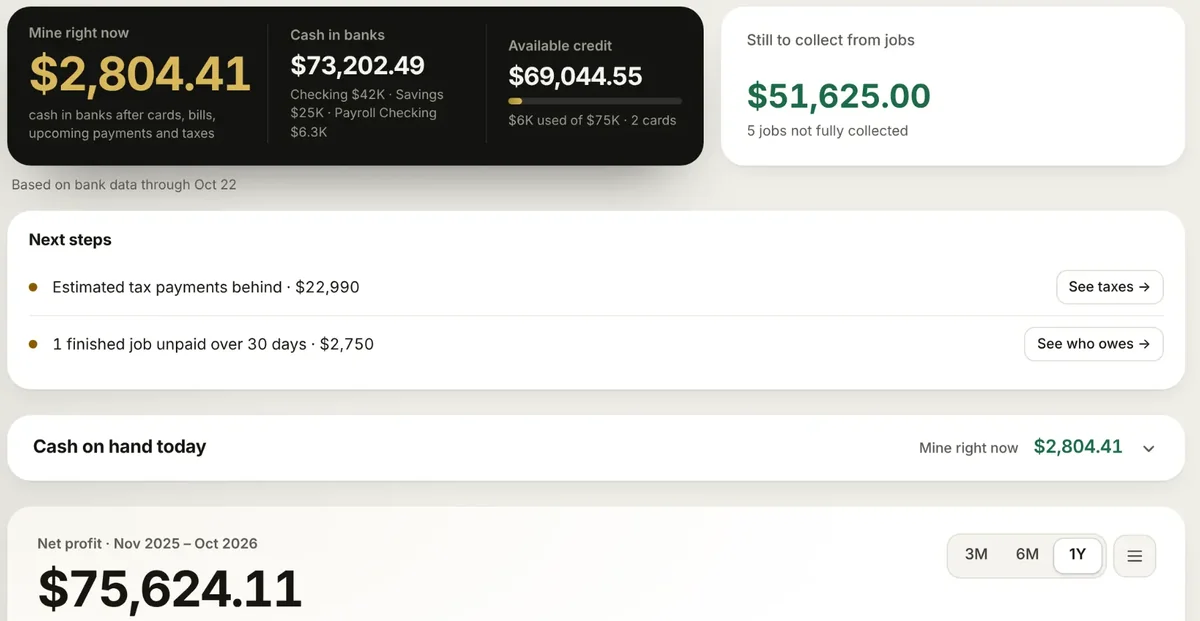
Trinity shows "Mine right now" on the first screen, from your real bank and card data, next to cash in banks and money still to collect from jobs. Our team checks it every week, and your part is one minute a week.
This article is general information, not tax, legal or accounting advice. Trinity CEO is not a CPA firm. Talk to your CPA about your situation.